
Categories: AI Video Workflow, Creator Strategy, Production Process
Tags: seeddance, seedance 2.0, content strategy, audience growth, creator workflow
Introduction
Publishing more content is not the same as building momentum. In a crowded feed, the difference between content that compounds and content that disappears usually comes down to process: who it is for, what value it delivers, how clearly it is packaged, and whether you keep improving it over time.
These 10 content creation best practices provide a practical operating system for creators, marketers, and small teams. The goal is not to do everything at once. The goal is to build a repeatable workflow that makes good content easier to plan, produce, distribute, and optimize.
1) Know Your Audience
Strong content starts with a clear understanding of the people you want to reach. That means moving past broad demographic guesses and getting specific about goals, frustrations, habits, platform preferences, and the language your audience already uses to describe their problems.
If you do this well, every later decision gets easier. Topics become sharper, hooks become more relevant, and the final content feels like it was made for a real person rather than for a generic market segment.
Practical ways to apply this:
- Review comments, support questions, and search queries to spot recurring themes.
- Build simple audience profiles around jobs-to-be-done, not just age or location.
- Compare what different audience segments actually click, save, and share.

2) Establish a Consistent Publishing Schedule
Consistency matters because it trains both your team and your audience. A regular cadence helps platforms understand your output, helps followers know when to expect new material, and reduces the chaos that comes from publishing only when inspiration happens to show up.
The right schedule is the one your workflow can sustain. Weekly high-quality publishing is better than an ambitious daily plan that collapses after two weeks.
Use a lightweight structure:
- Pick a realistic rhythm for each channel.
- Batch research, scripting, editing, and publishing by content type.
- Maintain a visible content calendar so the pipeline is never empty.

3) Focus on Value and Solving Problems
The best-performing content usually answers a question, removes confusion, teaches a skill, or helps the audience make a better decision. Value-first content outperforms self-promotional content because it earns attention instead of demanding it.
Before you start any draft, define the problem the piece is solving. That single constraint keeps the structure focused and makes the content easier to evaluate before publishing.
Useful prompts for planning:
- What question is this content answering?
- What mistake is it helping people avoid?
- What can the audience do differently after consuming it?

4) Optimize for Search Engines
SEO is not just a traffic tactic. It is a way to align your content with real demand. When you understand the phrases people search for and the intent behind those searches, you stop guessing what topics matter and start creating resources that stay useful for much longer.
That does not mean stuffing keywords into every paragraph. It means building content that is discoverable, well structured, and specific enough to satisfy the searcher.
At minimum, each piece should have:
- One clear primary keyword or topic target
- A title and description aligned with search intent
- Strong headings, internal links, and readable structure
5) Use Storytelling and Narrative Structure
Information helps people understand, but stories help them remember. A clear narrative gives the audience momentum: where they are now, what obstacle they face, what shift needs to happen, and what result becomes possible after that shift.
You do not need dramatic brand mythology for this to work. Even practical educational content benefits from narrative framing. A before-after-bridge structure, a real scenario, or a customer journey can make a lesson far more engaging than a flat list of tips.
To make this practical:
- Open with tension, not background
- Make the audience the hero, not the brand
- Use examples that feel concrete and recognizable
6) Create Multi-Format Content
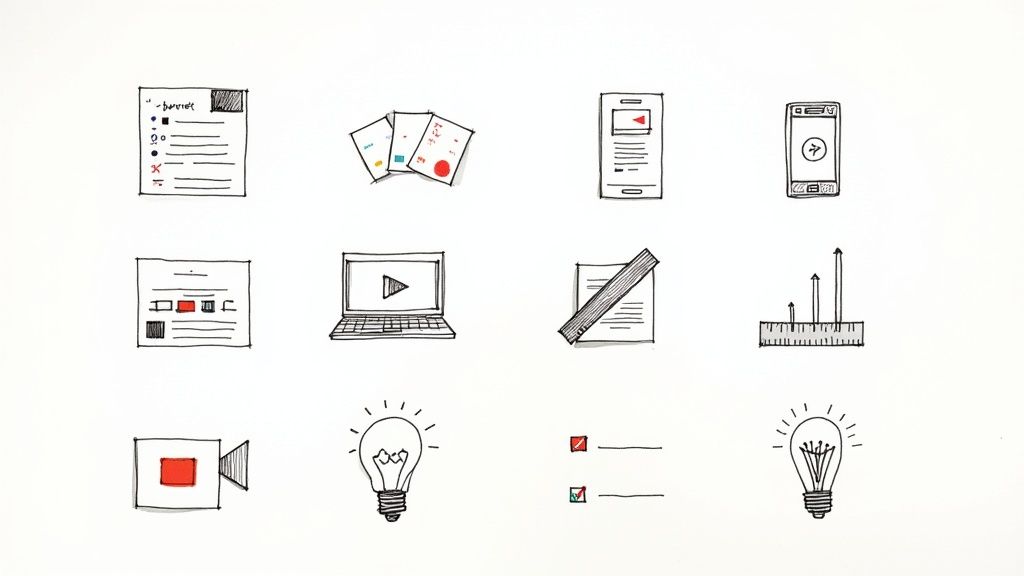
One of the highest-leverage best practices is repurposing a strong core idea across multiple formats. A guide can become a short video, a carousel, an email, a downloadable checklist, and a social clip. That increases reach without requiring a brand-new idea every time.
This approach works because audiences consume content differently. Some people want the long article. Some want the short clip. Others only engage with quick visual summaries. Multi-format distribution lets one idea travel further.
A practical workflow looks like this:
- Build one strong pillar asset first.
- Turn the core points into short-form derivatives.
- Adapt format, ratio, and pacing for each channel.
- Use tools like Text to Video and Image to Video to accelerate variant production.
- Refine the best-performing assets with Video to Video.
7) Prioritize Authenticity and Transparency
Polished content can attract attention, but authenticity keeps trust intact. Audiences are increasingly sensitive to generic, over-produced messaging. They respond better when the voice feels real, the examples feel lived-in, and the message admits nuance instead of pretending every process is effortless.
That can mean sharing lessons from failed experiments, being honest about constraints, or clearly disclosing sponsorships and affiliations. Transparency does not weaken authority. It usually strengthens it.
The standard to aim for is simple: clear voice, honest framing, and no invented certainty.
8) Optimize for Readability and Scannability
Most people do not read online content line by line. They scan for meaning. Good content design respects that behavior. Clear headings, short paragraphs, lists, and whitespace help readers find the answer faster and reduce the chance that they bounce before reaching the useful part.
Readability also matters for performance. Better structure improves user experience, supports SEO, and makes the content easier to reuse in other formats.
Simple editorial rules help:
- Use descriptive H2s and H3s
- Keep paragraphs short
- Break complex ideas into bullets, steps, or examples
- Highlight only the most important phrases
9) Include Clear Calls-to-Action
Every piece of content should make the next step obvious. If you solve a problem but never guide the audience forward, you waste a large part of the attention you just earned. A strong CTA connects the content to a meaningful action: subscribe, try a workflow, download a resource, or view the next related tool.
Good CTAs are specific, relevant, and well-timed. They appear after value has been delivered, not before.
For example, if your content teaches repurposing video assets, a natural CTA is to move from theory into execution with Video to Audio or Image to Video, depending on the workflow you want the audience to try next.
10) Analyze Metrics and Iterate
Content strategy improves when feedback becomes systematic. That means looking beyond vanity metrics and paying attention to signals that reveal actual behavior: retention, saves, click-through rate, conversion rate, completion rate, and assisted conversions.
The useful question is not "Did this get views?" It is "What did this teach us about topic selection, packaging, format, and audience intent?"
A basic iteration loop is enough:
- Define the KPI before publishing
- Review top and bottom performers on a fixed schedule
- Keep the winning structure, then test one meaningful change at a time
Putting It All Together
These best practices work as a system, not as isolated tips. Audience understanding shapes topic selection. Consistency keeps the pipeline active. Value and storytelling make the content worth consuming. SEO and readability make it easier to discover and absorb. CTAs and metrics turn publishing into a measurable growth loop.
That is the blueprint: understand, publish, solve, package, distribute, measure, repeat.
Conclusion
The creators who improve fastest are rarely the ones with the most ideas. They are the ones with the clearest feedback loop. Master these 10 content creation best practices, and you turn content from a random output into an asset that compounds over time.
Next Step
Choose one pillar idea, convert it into a video workflow with Text to Video or Image to Video, then review the metrics before producing the next round.
FAQs
1) Which content creation best practice matters most?
Audience understanding usually has the biggest downstream effect, because it improves topics, hooks, tone, and distribution choices at the same time.
2) How often should I publish?
Publish as often as your workflow can maintain quality. A reliable weekly cadence is usually stronger than an inconsistent high-volume plan.
3) What metrics should I track first?
Start with one KPI tied to the goal of the piece, such as retention, saves, CTR, or conversion rate.
4) Why is multi-format content so effective?
Because one idea can reach more people in the format they prefer, which increases total ROI from the original research and planning work.
5) How do I improve without creating more content?
Audit your existing library, identify the strongest themes and formats, and repurpose proven ideas before inventing new ones.