
Categories: AI Video Workflow, Creator Strategy, Tool Comparison
Tags: free sora alternative, sora 2, ai video generator, seeddance, free ai tools
Introduction
People searching for a "free Sora alternative" are usually not making a philosophical point about brands. They are trying to solve a practical problem: how do I test AI video tools without committing too much money too early?
As of March 27, 2026, OpenAI's Help Center still describes Sora 2 as the current Sora experience, while the older Sora 1 web experience is being sunset. So the category has not turned into a simple "Sora is gone, what now?" story. But the search intent is still real. Many creators want a tool that is easier to access, cheaper to experiment with, or better suited to daily testing.
This guide keeps the practical intent of the reference article, but frames it more accurately: what should you use when you want a low-cost or free alternative to Sora for testing AI video workflows in 2026?
1) What most people actually mean by "free Sora alternative"
Usually they mean one of four things:
- a tool with a free starting path
- a tool with enough trial usage to evaluate quality
- a tool that lets them test prompts without committing to a larger plan
- a workflow where one platform is used for exploration and another is used for final output
That last point matters. In practice, many creators do not need one tool to do everything for free. They need a workflow that lets them learn cheaply and publish selectively.
2) The free Sora alternatives worth testing
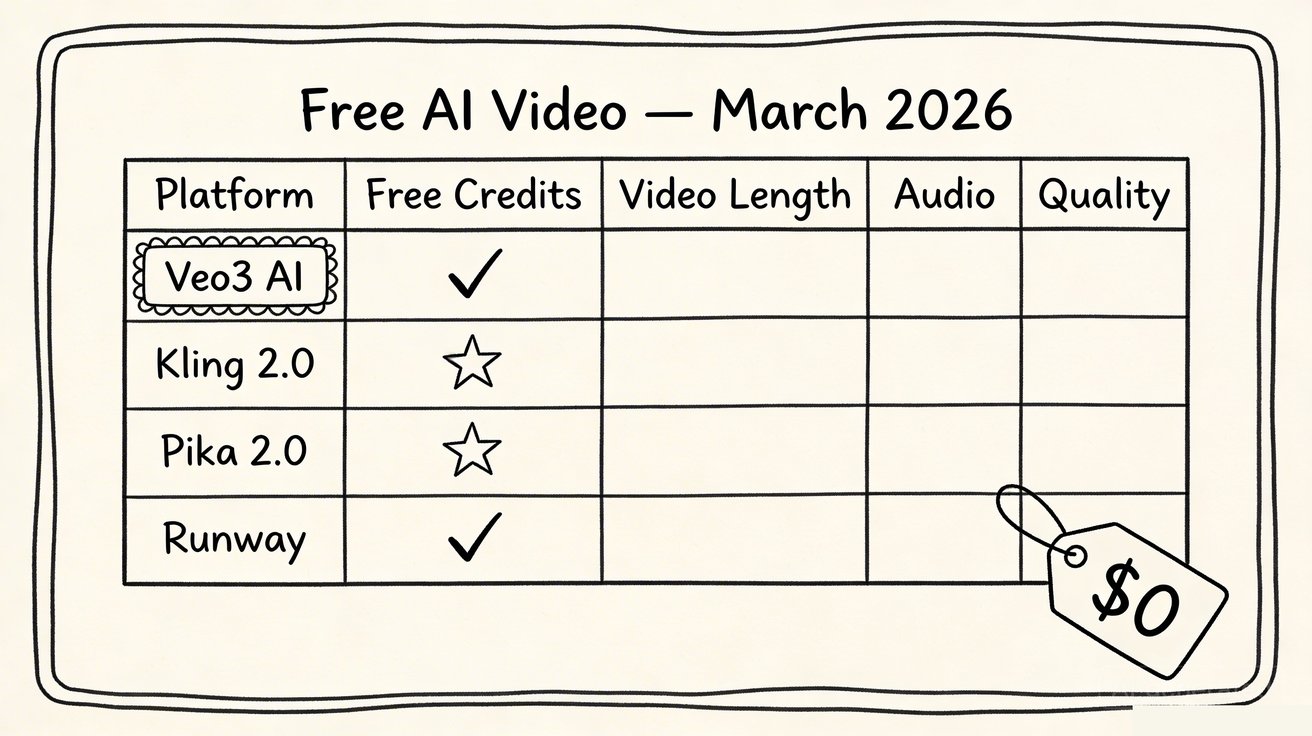
Veo3 AI for best free-quality starting point
If your priority is seeing how high-end AI video can look before you commit to a larger workflow, Veo3 AI is a strong first comparison. The reference article positions it as the best quality-first free alternative, and that logic is sound for creators who care most about visual output from text prompts or still images.
Best for: testing polished outputs, marketing visuals, product concepts, and quality-first clips.
Watch-outs: high-end output is useful, but quality-first tools are not always the cheapest place to do endless iteration.
Kling for ongoing experimentation
Kling is often more interesting when your main problem is volume. If you need to try many prompts, compare variants, and refine ideas quickly, a tool that supports repeated low-cost testing can be more valuable than a tool that produces the single best-looking clip.
Best for: daily prompt testing, iteration-heavy workflows, and short-form experimentation.
Watch-outs: fast iteration does not always equal the most refined final output.
Pika for lightweight social use
Pika is useful when simplicity matters. If your goal is to move quickly from idea to draft without learning a heavier production interface, it can be one of the easiest ways to test AI video creation.
Best for: solo creators, social content experiments, and lightweight drafts.
Watch-outs: simple tools usually trade away some control and some polish ceiling.
Runway for free trial-style control testing
Runway is still relevant in this conversation because free access is not only about quantity. It is also about learning whether a more advanced control-oriented workflow is worth paying for. If your team cares about direction, composition, and shaping motion inside the tool, Runway is a useful comparison even if it is not the most generous free path.
Best for: creative teams evaluating whether more control justifies a more complex workflow.
Watch-outs: it is better treated as a control test than as a pure "free volume" tool.
Seedance for multi-model exploration
Seedance becomes useful when your question is not "which one free tool should I use forever?" but "how do I test several model paths without rebuilding the whole workflow?" That is especially helpful for teams comparing text-to-video, image-to-video, and alternate generation routes in one place.
Best for: creators and teams who want to compare several AI video directions before committing.
Watch-outs: a multi-model workspace can be broader than what a single-purpose beginner needs.

3) A better way to think about "free"
The wrong question is: which tool gives me the most theoretically free output?
The better questions are:
- Can I test enough prompts to understand the tool?
- Can I get at least one or two clips that reflect real production quality?
- Can I decide quickly whether this workflow fits my use case?
- Can I avoid burning time on a tool that only looks good in demos?
Free access only matters if it helps you make a better decision. Otherwise it is just a slower way to waste time.
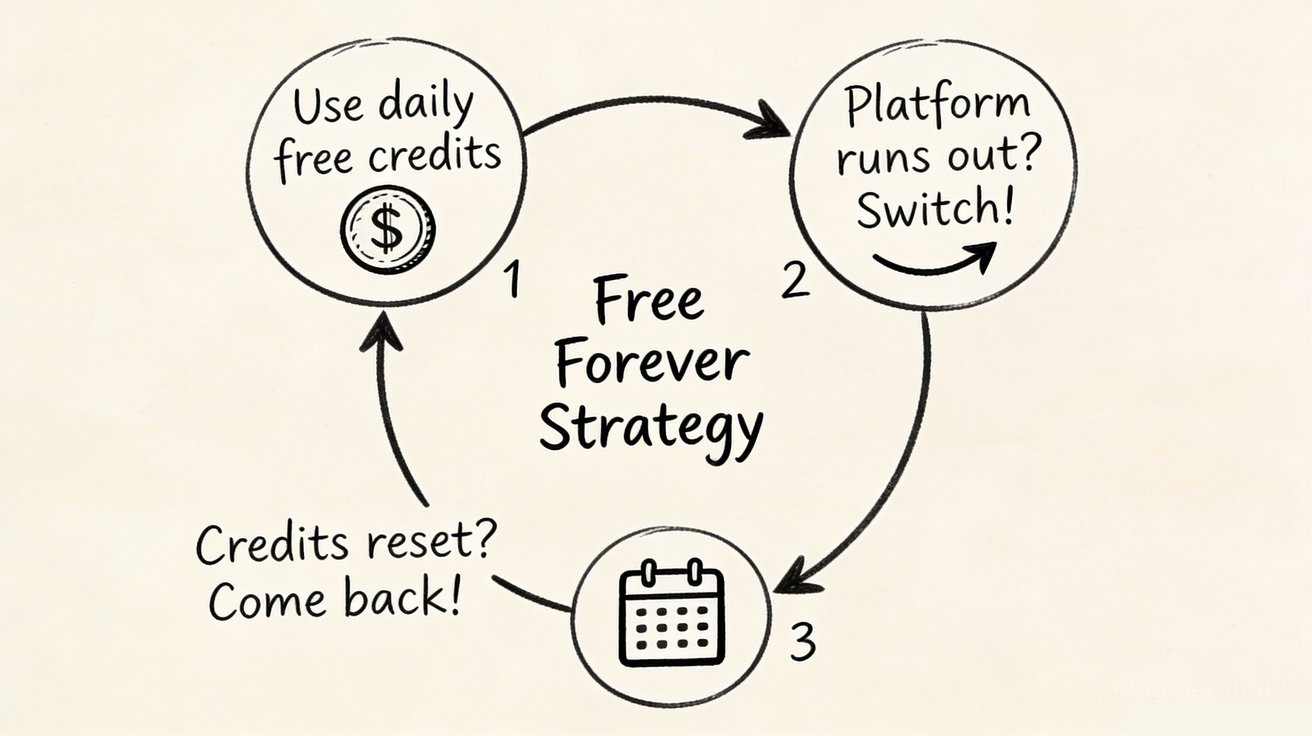
4) A smart free workflow
One of the most practical ideas from the reference article is to separate exploration from finalization.
That usually looks like this:
- Use a faster or more repeatable tool to test many prompt directions.
- Narrow down the best concepts.
- Move the winning prompt into a quality-first tool for the final version.
- Keep notes on what worked so the next round costs less time.
This is often a better strategy than trying to force one platform to be both your unlimited sandbox and your final production environment.
5) How to compare free Sora alternatives fairly
Use the same three to five prompts across every tool and judge them on the same criteria:
- output quality under motion
- prompt adherence
- time-to-usable result
- ease of repeating the workflow
- how quickly the free path reveals the tool's real strengths and weaknesses
That method will tell you more than any landing-page promise.
It is also worth treating free-tier details as variable. Access rules, credit policies, queues, and limits can change quickly. So the stable thing to compare is not the headline offer. It is the workflow value you get from the free path.
6) What to do if you want one place to compare options
If your goal is to test several AI video workflows without starting from scratch every time, start with Seeddance, then compare the same brief across Text to Video, Image to Video, and Video to Video.
That approach is often more useful than arguing about which tool is "best" in the abstract. You learn faster when every comparison uses the same brief, the same review criteria, and the same success definition.
Conclusion
The best free Sora alternative in 2026 depends on what you want from the word "free."
- Choose Veo3 AI if you want the strongest quality-first starting point.
- Choose Kling if your priority is repeated experimentation.
- Choose Pika if simplicity matters most.
- Choose Runway if you want to test whether more control is worth the added workflow complexity.
- Choose Seedance if you want a multi-model workspace for comparison instead of a single-tool bet.
Sora still exists as Sora 2, but that does not change the practical need behind this keyword. Creators still need a cheaper way to learn, compare, and validate AI video workflows before they spend more.
Next Step
If you want to test several AI video paths in one place, start at https://seeddance.app/ and run the same brief through multiple generation modes before you decide which workflow deserves your budget.
FAQs
1) What is the best free Sora alternative?
There is no single answer. Veo3 AI is a strong quality-first option, Kling is useful for repeated testing, Pika is easy for lightweight drafts, and Seedance is helpful when you want to compare several routes.
2) Is Sora fully gone?
No. As of March 27, 2026, OpenAI's Help Center still describes Sora 2 as the current experience, while the legacy Sora 1 web experience is being sunset.
3) What is the smartest way to use free AI video tools?
Use one tool for exploration and another for final output when necessary. That usually gives you better learning efficiency than forcing one platform to do everything.
4) Should I choose the tool with the biggest free offer?
Not automatically. The better choice is the tool whose free path teaches you the most about whether the workflow fits your real use case.
Media References
- https://cdn.seeddance.app/blog/free-sora-alternative/20260327110244-3ifxrptd.jpeg
- https://cdn.seeddance.app/blog/free-sora-alternative/20260327110245-vzbcd6t7.jpeg
- https://cdn.seeddance.app/blog/free-sora-alternative/20260327110246-rgxtrbz9.jpeg
- https://cdn.seeddance.app/blog/free-sora-alternative/20260327110247-5q2gum0q.jpeg
- https://cdn.seeddance.app/blog/free-sora-alternative/20260327110248-sxfy0yxv.jpeg
- https://cdn.seeddance.app/blog/free-sora-alternative/20260327110249-63b4555p.jpeg